An inside look at branding, creativity, and the human side of design in 2026.
Here’s a little challenge: If we removed your logo from every social media post, advertisement, and marketing material your business has published, would people still recognize your brand?
Think about that for a second.
Would they recognize your colors? Your typography? Your photography? Your personality? Or would your content look like something they’ve already scrolled past a hundred times?
As designers, this is one of the most interesting questions we can ask businesses today. Because creating something that looks professional has never been easier. But creating something that people actually remember? That’s a different conversation.
Everyone Can Be a Designer Now. Or Can They?
Let’s give credit where it’s due. Design platforms, ready-made templates, and AI-powered tools have made creativity accessible to millions of people. Small businesses can produce attractive graphics without hiring an entire creative department. Nonprofits can launch campaigns with limited resources. Entrepreneurs can experiment with ideas before making major investments.
That’s progress, and we welcome it.
But there’s a difference between having access to design tools and understanding how to use design strategically.
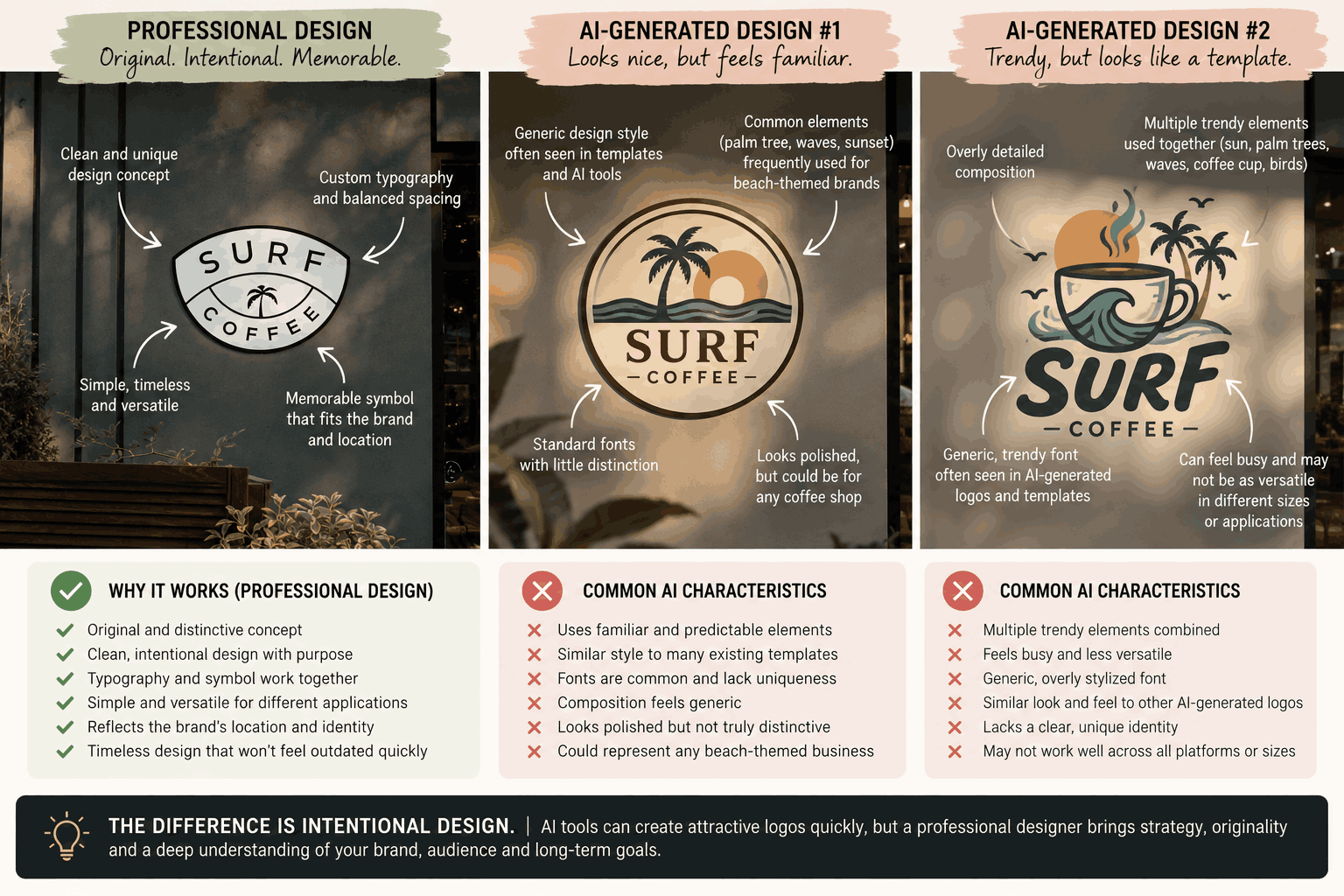
A template can give you an attractive composition. It cannot automatically tell you whether that composition communicates your brand’s personality, speaks to your customers, or differentiates you from the business down the street.
AI can generate dozens of logo concepts in minutes. But someone still needs to ask whether those concepts are distinctive, practical, accessible, appropriate for the audience, and suitable for the places where the brand will appear.
Design tools help us create. Design thinking helps us decide what deserves to be created.
And that distinction matters more than ever.
The 2026 Design Shift: People Want Something That Feels Human
Here’s where things get interesting.
Canva’s 2026 Design Trends report describes this year as Imperfect by Design. Drawing on platform search trends, input from its designer advisory board, and a survey of 1,000 creators, Canva found that 80% of surveyed creators believed 2026 was a year to regain creative control, while 77% described AI as an essential creative partner.
In other words, technology is becoming part of the creative process, but creators are also looking for more individuality and personal expression.
Adobe’s 2026 Creative Trends report identifies a similar direction: emotional connection, playful experimentation, sensory experiences, and authentic local storytelling.
These findings don’t mean polished branding is outdated or that businesses should intentionally make their graphics messy. They suggest something more meaningful: when professional-looking content becomes easy to produce, appearance alone may no longer be enough to distinguish a brand.
Your business needs something that feels like you.
Let’s Play: The Five-Second Brand Recognition Test
Imagine seeing three advertisements from businesses in the same industry.
Brand A: Beautiful photography, a fashionable font, neutral colors, and a popular social media template.
Brand B: A bright design, bold text, and a trendy visual effect you’ve seen on dozens of other accounts.
Brand C: A consistent visual style, recognizable typography, original photography, and messaging that reflects the business’s personality.
Now remove their logos.
Which one would you recognize if you saw it again tomorrow?
There isn’t a guaranteed winner based on those descriptions alone. A template can be customized into a strong brand, and original design can still be ineffective.
But the exercise illustrates something important: brand recognition depends on the identity and associations an organization builds consistently, not simply whether an individual graphic looks attractive.
A recognizable brand develops a visual language. Its elements work together across its website, social media, presentations, advertisements, packaging, and customer communications.
A logo identifies your business. Your brand gives people reasons to remember it.
Your Brand Is More Than a Color Palette
Here’s another question we love asking clients:
If your business were a person, how would you describe its personality?
Would it be approachable and friendly? Confident and sophisticated? Innovative and energetic? Warm and community-focused?
There isn’t one correct answer.
A healthcare organization may need to communicate clarity, reassurance, and professionalism. A neighborhood café may want to express warmth, personality, and familiarity. A technology company may emphasize innovation, reliability, and simplicity.
The designer’s job is to translate those characteristics into a cohesive visual experience.
That involves decisions about typography, imagery, spacing, contrast, hierarchy, tone, accessibility, and consistency.
It also requires understanding who the audience is and what the organization wants people to do.
For example, a beautiful advertisement is less effective if customers cannot understand the offer. A visually striking website can still frustrate visitors if navigation is confusing. And a memorable social media post may not support business growth if it has no connection to a larger strategy.
Good design isn’t decoration added at the end.
It’s communication with a purpose.
What About AI-Generated Graphics?
We use technology because it can help creative teams explore ideas, improve workflows, and work more efficiently.
AI-assisted design can be useful for brainstorming concepts, experimenting with compositions, preparing initial drafts, and adapting content for different formats.
But AI-generated output still needs human evaluation.
Is the message accurate? Does the imagery reflect the people the business serves? Is the design accessible? Does it align with the existing brand? Are the assets appropriately licensed for their intended use? Will customers recognize it as part of the same organization?
These questions become especially important for businesses operating across multiple channels or working in sectors where accuracy, trust, and accessibility matter.
The goal isn’t to choose between AI and professional designers.
It’s to use the right tools while keeping creative judgment, brand strategy, and accountability in human hands.
The Real Cost of Looking Like Everyone Else
Businesses sometimes view branding as a one-time task: create a logo, choose a few colors, and start posting.
But as an organization grows, its visual identity needs to work across more situations.
Consider a small business expanding from Instagram into e-commerce, email campaigns, printed materials, and a second location. Without a clear brand system, different pieces of content can begin to look unrelated.
The same challenge applies to nonprofits developing fundraising campaigns, universities communicating with prospective students, and larger organizations coordinating content across departments.
A professional designer can help establish reusable brand guidelines, templates, typography standards, image treatments, and design components that make future content easier to produce consistently.
And here’s something business owners may find surprising: working with a professional doesn’t mean abandoning templates.
A well-designed, reusable template system can actually be one of the most practical deliverables a designer creates. The difference is that those templates are built around your brand rather than requiring your brand to fit someone else’s design.
That can save time, simplify collaboration, and help teams produce more cohesive materials.
So, How Do You Know If Your Brand Needs Attention?
Before investing in a complete redesign, ask yourself a few questions:
- Would someone recognize our content without seeing our logo?
- Do our website, social media, and marketing materials feel like they belong to the same business?
- Can customers quickly understand what makes us different?
- Are our designs accessible and easy to understand?
- Do we have brand guidelines our team can actually follow?
- Are we creating content with a clear purpose, or simply because we feel we need to post something?
If several answers are unclear, you may not need to start over.
You may need a stronger foundation.
Sometimes that means refining an existing identity. Sometimes it involves building a consistent design system, improving messaging, or developing original campaign concepts.
And sometimes a business has grown enough that a more comprehensive branding strategy makes sense.
The right solution depends on where the organization is today and where it wants to go.
At Creative Impact Solutions, We Design With Purpose
At Creative Impact Solutions (CIS), we believe a brand should communicate more than what an organization sells. It should help people understand who that organization is, what it stands for, and why its work matters.
That’s why we approach graphic design as part of a broader digital strategy.
Our team considers how visual identity connects with website experiences, social media, digital marketing, customer communication, and long-term business goals.
We work with organizations at different stages of growth, from smaller businesses establishing their presence to nonprofits and larger organizations looking to strengthen their existing brand.
Not every project requires a complete rebrand or a large budget. Sometimes a few thoughtful improvements can make an existing identity more consistent, functional, and effective.
And that’s the value of working with a creative partner who understands both design and the technology supporting it.
Because the goal isn’t simply to create another attractive graphic.
It’s to create a brand people recognize, understand, and want to connect with.
So we’ll leave you with the same question we started with:
If we removed your logo tomorrow, would your customers still know it’s you?
If you’re not sure, it may be time to take a closer look at your brand.
Creative Impact Solutions — Helping organizations build meaningful digital experiences through thoughtful design, technology, and strategy.
Explore our branding and graphic design services, or connect with our team to discuss your next project.